Wednesday, March 16, 2022

UPPER EGYPT - PART TWO

 NILE CRUISE

After we left Abu Simbel we had another night in our hotel in Aswan and were scheduled to board the river boat to depart about 2:00 pm.  The morning was our free time.  As a group we decided to visit the unfinished obelisk.  This is a fascinating artifact because it shows how they actually make these monuments by having stopped in the middle of the process.  They were "carving", I should say hammering, the granite with a harder stone called diorite to remove the obelisk from the mountain.  (As Michelangelo said, he doesn't carve a statue, he just removes the unnecessary stone from around the object he already sees in his mind.  Good job if you can do it.)  Unfortunately, a crack developed at the pyramidal top, but with so much work already completed, like good designers/fiscal managers, they decided to just make it shorter and continued working... until the bottom cracked and they abandoned the work in situ. 

Catherine photographing obelisk still embedded in the mountain.  Crack can be seen at top.

Bill using diorite stone helping to free the obelisk from the mountain below.

After reviewing the quarry the group separated to walk the Aswan souk before returning for lunch and our cruise.  This was our first real experience with the Egyptian hawkers.  They are friendly, but relentless.  "Just come look... no hassle (as they hassle you)... very good deal (as they start out about 75% more than you'll pay)... Hey, good to see you again, I work in your hotel kitchen (they just make the shit up to get you in)...  excellent quality! (only to find later they dye cheap saffron red to look better, spray paint brass on tin, paint gypsum replicas and claim its basalt, use banana leaf instead of papyrus, and many are made in China.  Caveat Emptor!)  While I am generally comfortable with politely blowing them off or bantering as I walk by, several in our group were so hassled by them they avoided running the gauntlet to get back.  We found this time and again unfortunately.  Even in the city away from the souk, you think they are trying to help you with directions, or ask where you are from, ultimately, in time, they recommend a shop.  "My sister works here, she is getting married tomorrow, maybe you come."   We were friendly to one who helped us cross a Cairo street.  When we got there his "sister" was about forty.  He painted Robin's name in Hieroglyphics on a papyrus painting (banana leaf) as a "gift".  He left and we didn't want it.  She was insulted when we only offered only a dollar just to get away.  We left.  The photos are the real souk for the local people, not the tourist trinkets.

Lots of metal smith shops.  I don't see how they can make a living
having so much inventory in so many shops

Beware of the Saffron.  I talked to several sellers and played them off each other. 
I finally bought a batch from two different shops. Found out tricks of the trade
as they undercut the quality of their competitors.  (PS Iran saffron best, and not all red)

The vegetable and meat markets were the best, and least likely to rip you off.  
Dates and sweets the best for traveling

Side of sheep anyone?

Delivery day.

We also popped into a Coptic Church.  This is one of the earliest Christian communities.  Founded by St. Mark not long after Jesus' crucifixion.  The Coptic church is one of the Eastern Orthodox denominations and shares many practices.  However, it split from other Christian churches in 451, before the Orthodox split from Rome in 1054.  

Interior.  Eventually the yellow windows will be replaced with stained glass.

Typical Orthodox church Icon screen.  Usually they place a framed Icon at the entry
for penitents to kiss as they enter.  Not great during Covid.

I originally wanted to take a felucca boat trip with only limited people down the Nile and was disappointed we were going to be on a "cruise" ship.  Being here I realized my folly.  A felucca on a three day trip would be very in convenient and uncomfortable.  They are dependent on the wind, so no guarantee where you will anchor, they have limited cooking facilities, you sleep on the deck outside only under a canopy, and there can be flies and heat in the summer. The cruise ship was for 150, but being off season we didn't have that many.  And the top deck was a wonderful place to watch the land go by as centuries past.  We still got our felucca ride on the afternoon in Aswan after Abu Simbel.  They are beautiful and graceful ships, iconic on the Nile. 

After returning to our boat after the souk, we had a buffet lunch while we cruised down the Nile to our first stop Kom Ombu for a sunset tour. It's interesting that most of the temples in Upper Egypt above Luxor were actually built by the Greek Ptolemy dynasty after 350 BCE.  They were often build on the site of previous Egyptian temples.  I can't be certain but they have an elegance that is Egyptian worshiping their gods, and refined like the Greek temples.

The fertile land, irrigated by the Nile, glides by while the desert claims the horizon.

Most cruise ships follow a similar schedule going from Aswan to Luxor and stop at the same sites.  Our guide Ahmed was terrific at running ahead to get tickets.  We were often first in line.  Kom Ombu is a unique temple as it is dedicated to two gods:  The left half is dedicated to the falcon god Horus while the right side is dedicated to the crocodile god Sobek.

Sunset at Kom Ombu

Fantastically carved columns and walls with stories of gods in pictures and writing.

Descriptive image of Lower Egypt on left and Upper Egypt on right putting the combined crown on the Pharaoh while Horus looks on from the right with Ra (sun disk) on his head.

Leaving the temple at sunset as the crowd enters .

2500 year old mummified crocodiles they revered.

All the cruise boats tied up at the pier during the tour.

After Kom Ombu we cruised a few hours at night to dock at our first morning tour the Temple at Edfu.  This is one of the best preserved temple in all Egypt consecrated again to Horus, the falcon.  Work started in 327 BCE and continued up to Cleopatra VII.  Again Ahmed got us up pre-dawn before the crowd from other ships.  However, the gate didn't open and by the time it did we were surrounded.  But Ahmed got us through quickly by knowing the ropes.
Early morning crowd waiting to get in.  Not a lot of masks.

Entry to the temple.  
Typical poses of Pharaohs with arm raised striking down their enemies.

Entry guarded by Horus, the falcon

Interior courtyard

Beautifully carved and colored columns

Colors over 2500 years old.

Another god Thoth, the Ibis god, with crown representing Osiris 
(too long story about Osiris and Isis)

Exterior of the facade showing many gods with their various crowns.

Primary Egyptian Gods.  Love Nut spreading over the earth in a starry sky!

After our tour of Edfu, we continued down the Nile.  As we approached the locks Ahmed advised us what we would encounter as we queued.  A swarm of row boats will approach showing their linens entreating you to buy.  They will toss up packages forty feet or more hoping to get you to "just look".  I had a discussion with an Algerian Frenchman as we watched this back and forth of packages. I thought it was pretty sad they had to do this for food.  He just dismissed me that it's their lot in life and they like it.  "They are happier than we".  Reminded me of Imperial Britain's "The White Man's burden", or that slaves are happy this way.  A reminder of how we all see things so differently.  I walked away as he kept talking without stoping.  

Ships lined up for the locks with hawkers attacking like Somali pirates.

Sellers preparing to toss up their wares forty feet in hopes for a buy.

Evening entertainment, a Whirling Dervish from the Sufi religion in Turkey.  
The real ones do it for spiritual reason all in white.

Egyptian belly dancer.  Lacked the body control and sensuality of previous encounters. 

Next Post:  UPPER EGYPT - PART THREE  Luxor and Karnak

Tuesday, March 15, 2022

UPPER EGYPT - PART ONE

 ASWAN AND ABU SIMBEL

The Old Kingdom was primarily located in Lower Egypt whose main artifacts are the Pyramids in Giza that we visited, and even older ones in Saqqara, Dasher, and Maydum, which gives us reasons to return.  The New Kingdom (see timeline in the Overview) is primarily located along the Nile in Upper Egypt between Luxor and the Sudan border, though there are temples from other periods along the entire stretch of the Nile.  

Aswan is at Philae temple at the bottom.  Other sites shown as well.

As I mentioned in the Egypt Overview, there is too much to describe about Egypt's history, religion, art, architecture, culture and more.  I also think readers are mostly interested in a travelogue with images rather than a course on Egyptology which, despite our recent eduction, I am not qualified to give anyway. Therefore, I will limit my comments to only our sites and perhaps an interesting relevant description rather than detailed explanations.

We arrived in Aswan on the east bank of the Nile late morning.  Aswan is located between two dams on the Nile: an old dam built downstream and raised several times between the 1880s and 1930 for flood control and irrigation.  It was the largest gravity masonry dam at the time.  Before the dam, Aswan was located at the the "first cataract" of the Nile where the river tumbled and cascaded over rocks and falls (think Columbia river before dams).  It was a tourist destination starting in the late 1800s with the construction of the Old Cataract Hotel hosting many dignitaries including Kings, Queens, and Winston Churchill.  

Old Cataract Hotel and Felucca

When the old dam was raised the final time it flooded an island called Philae where the temple to the goddess Isis was located.  Prior to the flooding, the temple blocks were disassembled, moved to a new island in the river, and reassembled like Lincoln Logs. This temple was our first stop.  It was built by the Ptolemys, the Greek rulers of Egypt, to respect/mollify the local population into accepting their rule.

Ferry to the Island of Philae

Approaching the Philae Temple

Common relief carvings on temple face of gods and Pharaohs in the center.

The entire interior surface is carved with gods, Pharaohs, wives, slaves, enemies and Hieroglyphics.  

Group of young muslim women wanting their photo taken.

After our return from Philae the Nile was covered with Feluccas for afternoon tourist cruise

The cruise ship Sudan, where they filmed the original Death on the Nile.

The next day was long and a highlight.  We left before dawn for a four hour drive through the empty desert almost to the Sudanese border to see Abu Simbel.  This dual temple is dedicated to a trinity of gods (different trinity), but mostly glorifies the builder Ramses II and his wife.  Not only are the temples monumental and breathtaking, carved into the mountain face in a remote desert (step aside Mt. Rushmore), its salvation is a story unto its own.  

Exterior of Abu Simbel with four towering statues of Ramses II.
Note: the mountain it was carved into was cut into blocks and relocated uphill

The relocation team decided that the previously collapsed heads buried in the sand
would be reinstalled as they found them.  

All these statues remind me, with much more meaning now, of a poem by Shelly "Ozymandias".

I   I met a traveler from an antique land,
Who said - "Two vast and trunkless legs of stone
Stand in the desert.... Near them, on the sand, 
Half sunk a shattered visage lies, whose frown,
And wrinkled lip, and sneer of cold command, 
Well that its sculptor well those passions read
Which yet survive, stamped on these lifeless things,
The hand that mocked them, and the heart that fed;
And on the pedestal, these works appear:
My name is Ozymandias, King of Kings;
Look on my Works, ye Mights, and despair!
Nothing beside remains.  Round the decay 
Of that colossal Wreck, boundless and bare
The lone and level sands stretch far away."

A common carving of Ramses II with leg forward and arm raised striking down his enemies.
Note:  Ramses II crown is a combination of two.  The cone shape of Lower Egypt in the center,
and the wrap-around with high back of Upper Egypt.  This is because he ruled both Upper and Lower.  
To the right is the god Harakhte, with Falcon head and Solar disk offering a feather.

View of both Ramses II temple in distance, and his wife Nefratari (not Nefratiti) in foreground.

Nefratari's temple.  
While there are statues of wives, often shown with great affection,
seldom are they shown with equality to the king. She is in the center of each triplet. 

Nefratari flanked by Ramses II

The temple was only discovered in the early 1800s when the top of the frieze was seen sticking out of the sand.  The rest was buried.  During the 1960s the High Aswan dam built below the temples was filling up without a plan to save the them. The public outcry encouraged UNESCO to step in and provide funding to save the monument.  Its location along the Nile, but several hundred feet below the final level of Lake Nasser behind the dam, required new innovations in construction.  
Original location of Abu Simbel carved into sandstone mountain and
was covered by sand up to heads and top frieze.

They considered coffer dams to surround it for visitors to descend surrounded by water, but considered too risky.  They decided to cut it apart and relocate it several hundreds of feet up the cliff.  Not just the monument, but the mountain face as well.  In addition, due to the lack of planning in advance they had to race against time as the lake was filling up.  It is magnificent!  And in the middle of nowhere - still.

Location of temple before and after relocation.  
Section showing the concrete shell over the interior and the relocated face of the mountain.

Mirage in the desert on our return drive.

After our return we had our home stay dinner with a Nubian family.  As previously mentioned, the Magreb along the Mediterranean coast is primarily lighter skinned and not black African, even before the Arab conquest.  They were descendants of Phoenicians, Berbers, Greeks, and Romans; traders along the sea. But south of the Atlas mountains in the west and into the desert away from the coast they are decidedly dark skinned African. The Nubians are the African peoples south of Egypt. 

The wife Mona.  She was a funny and feisty woman.  
Told how she refused the marriage proposal from her husband several times.  

Relative of Mona and her husband's

We had many Egyptian meals in restaurants (not much else).
Mona began cooking at noon, and without exaggeration, the best we had.

Next Post:  UPPER EGYPT - PART TWO.  Nile Cruise, Luxor and Karnak


Monday, March 14, 2022

LOWER EGYPT - PART TWO

 ALEXANDRIA

Our second day we drove four hours in our mini-bus NW from Cairo to Alexandria (pronounced al-ex-on-DREE-a) on the Mediterranean.  This city is the second largest in Egypt and a major port.  It was eponymously named after its founder Alexander the Great.  Most tours skip this side trip because it is not filled with temples or great antiquities like Cairo or Upper Egypt. However, I specifically selected this itinerary because I wanted to see this city of historic significance.  


The Cornish from our hotel window.

Their buildings are in not much better shape than Havana.  
And this is the high rent district along the Cornish.

Walking the back streets we saw results of their crazy drivers and traffic.


Besides its founding it was the capital during Cleopatra VII reign, and the love nest of her affairs with Julius Caesar and Marc Antony.  This is also where Cleopatra and Antony died in a Romeo and Juliet/West Side Story like ending   As Octavius (adopted son of Julius Caesar and later self-named Caesar Augustus) was closing in to end the Roman civil war - and the Republic - after Caesar's murder, Antony, believing that Cleopatra killed herself, unsuccessfully tried to commit suicide by a sword thrust to the gut.  Alas, she lived. He thereupon was taken to her where he died in her arms.  Upon his death, and Egypt’s loss to Octavius at Actium, she killed herself by the apocryphal legend of an asp bite to her breast.  This is unlikely as she was a master of the poison arts, her most probable method of dispatch.  


Legendary Love Affair, in life, art and life


Alexandria had one of the seven wonders of the ancient world – the Pharos Lighthouse.  Six of the seven, including the lighthouse, are gone; only the pyramids survive.  The lighthouse collapsed in an earthquake in the late fourteenth or fifteenth century. 


Model of the Pharos Lighthouse in Alexandria

There is now only a seventeenth century fortress on the site, supposedly built from rubble stones.  I’d love it, and think it’d be good for tourism, if they replicated it as it was almost as tall as the pyramids.


Fortress built from Lighthouse rubble on the Isle of Pharos 


There was also the Library of Alexandria, the largest and most significant library of the ancient world. This was part of a larger institution called a Mouseion dedicated to the Muses, from which we get today’s museum.  It is estimated that the library housed about 400,000 papyri from around the Mediterranean.   In 48 BCE during the Roman civil war, Julius Caesar, in support of Cleopatra’s claim to rule Egypt, had his soldiers set fire to Egyptian ships commanded by Cleopatra’s brother and rival for the throne.  The wind blew the fire from the harbor onto the library and set it ablaze destroying the entire contents.  Think how much we’ve learned from four Dead Sea scrolls; imagine what we would know of the times if even a fraction of the contents survived.


The library of Alexandria ablaze from the ships and the lighthouse at left

In 2002 a new “Bibliotheca Alexandria” was built on the site of the old.  Designed by a Norwegian firm after winning a competition it is dedicated to “recapture the spirit of openness and scholarship of the original Bibliotheca Alexandrina. It is much more than a library.”  Initially, I was unmotivated to see a modern library.  But after our tour I was very much impressed with both the architecture, it’s purpose, and the exhibits inside.  They also have fascinating online resources.  Check them out.  https://www.bibalex.org/en/default


Curving  exterior facade with all the alphabets of the world inscribed.


Cascading tiers of readers under sloping roof with shaded brows for light.


With the end of our visit to Alexandria we headed to the train station for a 15-hour overnight transit to Aswan in Upper Egypt.  We were escorted to the platform by armed security who stood guard around our baggage for several hours.  Tourism is the second largest economy in Egypt after the Suez Canal, so they want to be sure nothing disrupts that. Reassuring for us. The station was filled with young and old, conservative and modern Muslims.  


Guards and Guide watch over our baggage on platform


Only one other western group was waiting.  From them a tall middle aged Dutch South African approached. Their group had just spent the week camping in the Sinai desert. While I can certainly relate to the joy of camping in nature and a night under the stars, he beamed with the glow and blazing eyes of spiritual truth.  For all we know they might have ascended Mt. Sinai and encountered the blazing bush.  Of course, there is a convent at the site, and tours to where the bush was located and to the summit where Moses (Mose) received the tablets.  I assume the bush doesn't exist any longer.  We will encounter the group in the future, affirming my assumption about their "new age" spiritualism.  


Most tourists don’t take this train.  It is a local mode of transportation and not of the level of our Blue Star from Cape Town to Johannesburg, or the Ghan in Australia from Alice Spring to Darwin.  Because of this we were quite the fascination on the platform.  As different trains arrived and left, we’d be greeted from an open window and asked to be photographed, which we willingly engaged with our limited Arabic “Salam Alikum” greeting.  


Young people fascinated with crazy western travelers.


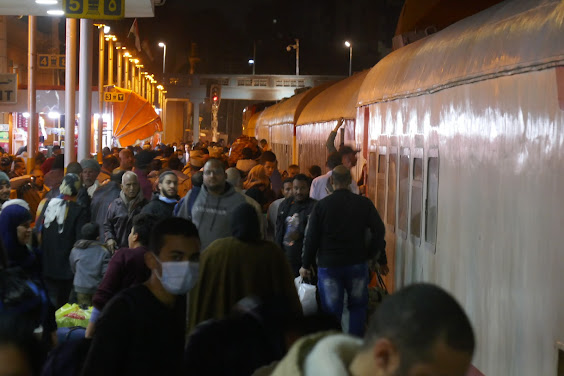
Boarding the local by the locals can be quite chaotic


Our train was scheduled to leave at 20:40; it left on Egyptian time at 22:00.


Next Post:  UPPER EGYPT - PART ONE