Sunday, January 23, 2022

CORNWALL

 LUCK RUNS OUT

After Connor and Brynne left Omicron continued to surge in the UK.  Teigan originally planned to celebrate New Years Eve with select friends, but decided to avoid the risk and spend it with us. The next day we went to her flat for dinner and spent the night.  On Sunday, Jan 2nd, Teigan had errands to run, but she and Robin wanted a girls' day with mani/pedies on Monday, and have a sleep over.  Bill was fully supportive of this getting a day and a half on his own and not having to watch another chick flick.  Robin came back Tuesday morning and said Teigan had a cold.  Hmm?  That afternoon Teigan called; "I tested positive for Covid". Shit! Robin is treated for a compromised immune issue and has been assiduously following all protocols, including wearing two N95 masks when outside and on the Tube.  Now she's just spent the day and night with an infected person... and I'm living with her.

Home antigen tests are free in the UK, but none were available at any pharmacy we called.  Finally, we went on-line and the manufacturer had plenty to sell and could deliver six tests the next day for £30. On Wednesday, only two days after exposure, we both took the test.  Is that a faint line for Robin where the positive result would be?  Not sure.  Bill tests negative. Four days after exposure, Teigan had full-on flu symptoms; fever, stuffy head, body aches, sore throat, tired, fortunately nothing needing emergency care.  We both took our test again.  Robin is definitly positive, but appears asymptomatic.  Bill is still negative, but everyone is predicting he's going to get it. Now Robin decides to sleep in the separate bedroom. Bill is fatalistic. Tick Tick Tick.  

Bill's negative left, and Robin's Day-4 faint positive right

After all the preparations and risk management Robin gets infected by a family member who could have been exposed only during 36 hours between visits - and has no idea where.  She felt very guilty, but we reassured her it wasn't her fault - eventually "some little bug will get you some day".  A week after exposure Teigan is starting to feel better, Robin is still feeling fine, and Bill is still negative. Looking at the web, asymptomatic people have a low viral load are unlikely to be infectious.  Seems like we both dodged a bullet.   

On the 10th we planned to take the train to Cornwall in SE England, and Teigan was to join us five days later.  Before we each got on the train we took another test and all results are negative.  Instead of being more vulnerable as originally told, Robin's treatments seem to have given her super-immunity. 

CORNWALL

It's a five and a half hour train ride from London to St. Ives near Lands End at the SW tip of England.  It's five hours north to Edinburgh, Scotland and only two and a half to Paris - so it's quite remote. 

Train route to St Ives from London

Cornwall is one of five or six, depending on how you count them, Celtic regions in the UK and Europe:  Scotland, Ireland, Wales, Cornwall, and Brittany in France.  The sixth are five tribes that settled in NW Iberian Peninsula (Spain).  Originally from central Europe the Celts migrated west in the sixth century B.C.E, or were pushed by the Vandals, Visigoths, or other Germanic tribes, to settle the British Isles. After invasions by the Romans, Vikings, the Angles and Saxons, and William the Conquerer from Normandy, they clung to the north, west and southern shores of the British Isles, and across the channel in France. Over the centuries the Celts ferociously fought England to maintain their independence (think Braveheart), but eventually succumbed to the sword or Royal marriages.  Despite "Homerule" accommodations, today there are still regional movements to become independent of England and the UK, and preserve their Gaelic languages.

Celtic Final Settlements in Europe

The Cornwall countryside is amazingly beautiful and lovely.  Not dramatic like the Alps, not austere beauty like the Namibian Skeleton Coast or Antarctic glaciers, not the mesmerizing allure of ocean waves and palm trees on a tropic beach, nor the wide open skies of the steppes in Mongolia or the US prairie.  It has a peaceful pastoral beauty of rolling green land criss-crossed by hedgerows, dotted by sheep, and surrounded by steep cliffs with sandy beaches lapped by crystal clear turquoise water.  It is only eight miles from north coast to south; St Ives to Penzance. 

Villages settled in pastoral countryside. 

Cornwall's economy was based on fishing, and mining copper and tin since the Roman times to the twentieth century.  There are UNESCO sites preserving this heritage in the region. But agriculture and tourism are now the dominant base.  Most surprising to us was the beauty of their many sand beaches.  I always thought of Britain's beaches as rocky or shingled like Normandy or Washington Coast.  You could put these buff colored beaches with their surfers on any tropical island and feel at home.

Historic mining shafts along the coast and inland.

But the beauty belies a turbulent side.  Many a ship has been dashed along these rocky cliffs exposed to the North Atlantic storms.  The RNLI (Royal Navy Lifeboat Institute) stationed along the coast has heroically sent volunteers into the furious froth and foam to save many, and losing a few volunteers along with the shipwrecked sailors.  The orange four-foot square life-ring stations that dot the coastal path around the peninsula is a reminder not all is tranquil here.  

North Atlantic storms attack lighthouse in Brittany

One of my reasons for wanting to come was walking the coastal path.  Our first "walkies" headed west from St. Ives for four miles along the cliff edge and four miles back through the fields.  English law allows footpaths through private property with "stiles" at the hedgerows to climb up and over while keeping animals on the right patch.  I advised everyone to take hiking shoes as this in England; in the winter; on rocky paths.  "If a man has an opinion in the forest and his wife's not there to hear it is he still wrong". Yes, I'm often told.  So we started our walk and it was beautiful.  Dramatic cliffs, moss covered slate roofed cottages, even periodic sun.  

Start of costal walk outside our Airbnb on the Atlantic coast.

But soon the path was very uneven, rocky, and covered in thick, slick mud and moss. Robin was increasingly unsteady in her running shoes, looking about to tumble trying to avoid puddles and mud, so I found a footpath through a field and short-circuited our eight mile loop trip to four. 

Increasingly wet and muddy coastal path

The next day we took a bus east for our starting point to walk back along the coast.  Except for one uphill patch, this was a little dryer and above a stunning long beach along Corbis Bay.  As we approached St Ives we noticed a big sign "G7" in front of a low level modern resort and realized this was the location where the UK hosted six other nations in June 2021.  Probably built for the event.

Corbis Bay beach and G7 resort.  Each cabin was for a countries retreat  

Robin and I took a bus to Penzance where we rented a car so we could pick up Teigan from the train the next day. After she arrived we took a couple other coastal walks.  As noted in previous blogs I love to go to the geographic extremes of places: furthest N, S, E, or W.  I had to go to Lands End, the furthest SW in Britain, despite being warned off.  It's a shame the land is privately owned as it's developed as a tourist destination with all the trashy entertainments.  We spent only fifteen minutes here before heading to a more natural coastal setting.  The National Trust should buy it and remove all the eyesores and restore it as a nature preserve.

East of Penzance is a headland looking toward an island accessible only at low tide called St. Michael Mount.  There is a more famous monastic retreat across the Channel, Le Mont St Michel.  At roads end, after blind corners and lane so narrow that brambles scraped both sides of the car, there was much skepticism about my route-finding and plan to walk another muddy path. Our walk here started across semi-dry fields and under a canopy of thickets until emerging on windswept rocky cliffs with dramatic pounding surf.  Thatched covered stone shelters clung to the sides with rusted winches that still haul small boats and their catches up and down from several hundred feet below.  You could imagine Ryan's Daughter being filmed here.  (It wasn't, filmed in Ireland.)  I was redeemed.  

Teigan as Ryan's daughter with Michael's Mount island in distance.


Local stone and thatched cottage above cliffs

Teigan had to work remotely one day, so Robin and I took off 2 hours east on the north coast to Tintagel.  On the headland outside this small and lovely village are remnants of a thirteenth century medieval fortress that was built on sixth century ruins.  Legend has it the earlier ruins was the castle of King Arthur and his round table.  This of course attract tourists, but not much in winter; the town was mostly shut down.  Despite all the Camelot books, myth and movies, if he existed he was probably a minor tribal leader of a band of animal hide covered brigands.  No knight in shining armor.  

Bill at thirteenth century remains of fortress above cliffs

Cornwall statistically has the best weather in the UK.  It's sunnier (relatively), dryer, and warmer. In our "could we live here" game we initially concluded that we would love it. More sun and less rain than Seattle but as green.  For an international destination, this would be ideal; close to Europe, english speaking, great walking, and fascinating history.  So we started asking the wait staff in St. Ives what it was like in the summer.  "Horrible" was the consistent reply.  It's a summer holiday destination for Brits and foreigners.  Roads are clogged, beaches packed, narrow cobbled streets filled with shoulder to shoulder tourists, and everything is booked.  Like many popular destinations these days, few actually live here, but rent units out.  It's loved to death.  But coming in the winter was lovely; if a little muddy.

Lovely St Ives with the tide coming in.  
Forth century St Nicholas Chapel on hill in distance (rebuilt after WWII)

Next Blog: Paris


Friday, January 21, 2022

CHRISTMAS IN LONDON


"TWO COUNTRIES SEPARATED BY A COMMON LANGUAGE" G. B. Shaw

The holidays are over, Connor and Brynne returned to the US, and Robin and I continue our homeless journey.  So the blog goes on.

While in Strasbourg the three of us got tested at an outdoor pop-up site and within 15 minutes received negative results.  This was efficiently logged on our EU app that also had our vaccination status for convenient access at the airport.  

Bill being swabbed at Pop-up testing facility 

We breezed through both airports and arrived at Paddington Station on the Heathrow Express after dark. (London is about the latitude of Ketchikan, AK so it was dark about 15:50 in mid-December.)  At Paddington Teigan headed north on the Tube to her flat near Camden Market and we went SW to ours in Fulham. Our Day-2 PCR tests ordered in advance arrived, so we took them and mailed the swabs to NHS for a 48 hour turn-around.  Of course, we didn't get our negative results back for a week.

Our flat was one level up from the street and then three levels.  The top floor was a kitchen and dining room over-looking the living room.  The main bedroom was in back of the living room, and the lowest level was the second bedroom and bath.

Living room from Kitchen Loft

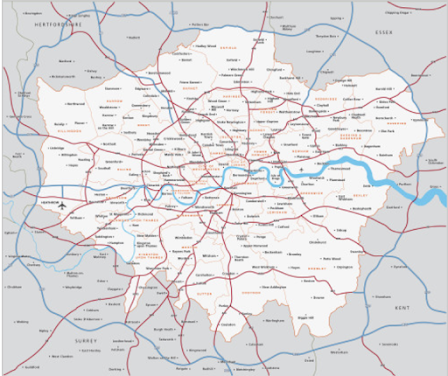
While we've been to London many times for business and travel we usually stay in Central London.  Staying in Fulham impressed us with how HUGE London's footprint is. London's 32 boroughs and New York City's five are approximately equal in population: 8.9 m to 8.4 m respectively, but London is over twice the area at 607 sq. miles.  While the Tube is quite fast there are only about half the miles of track in London compared to NYC, or one quarter per sq. mile serviced.  Their double deck busses are quite prolific, and make excellent less crowded rides, and you get to watch the city go by.  However, if traffic is bad  it can take quite a bit longer than the Tube.

City of London's 32 boroughs.  
The map below is inside the central ring road above.

While not exactly Arrondissements like Paris, London is surprisingly defined by neighborhoods, each with their own character.  For context, Fulham is on the Thames SW of Chelsea, which is SW of Westminster and Big Ben.  It's defined by a couple of trendy shopping streets; E-W Fulham Road and Kings Road, and N-S Wandsworth Bridge Road, where our flat was located. 

Central London.  Fulham is above the river bend in the lower left.  Camden, Teigan's flat, is an hour away at the NW corner of Regent Park, the green circular area in the upper left 1/3.  The London Eye (Ferris Wheel) is in the center just right of the Thames and across the river from Big Ben.

 
Within a week we found our favorite bakery (Born and Bread), cleaners, "off-license"  (convenience) store, pubs, and a lovely small restaurant serving their ubiquitous Sunday roasts with Yorkshire pudding.  With few exceptions, the Brits really don't have a cocktail culture.  On several occasions Bill offered to go behind the bar and show how to make Dry Martinis or Perfect Manhattans.  The staff were delightfully appreciative and fun.  

Robin in local restaurant for happy hour


We quickly began our habit of walking walking and more walking around The City.  One such trek was over ten miles from Fulham in the SW to Southwick in S Central, where our favorite open-air market is spread under a canopy of rail tracks.  You really get a feel for a city at that pace. All London residences are row-houses with rare exceptions.

Classic London neighborhood row-houses

Bill in outdoor Borough's Market

London began as a Roman outpost called Londinium.  As it grew it absorbed nearby towns a horsecart-ride away.  The former cities of Westminster, Chelsea and Fulham are now Boroughs of London, and the roads connecting them mostly follow these ancient wandering paths.  Because of this as you meander the road suddenly changes name or the road you wanted veered off.  Also, if you ask someone for directions you might not understand them: Leicester Square is pronounced lester square; Hautbois is hobbiss; Wymondham is win-dum; Costessey is cozy; and our market in Southwick is suth-uk.  

Trying to understand our own language is a study in humility.  Apartments are flats, the first floor is ground level and the second is the first floor; and you take the lift, not the elevator, to get there.  When you take a break, it's a holiday, and in the afternoon you'll have a biscuit with your tea, not a cookie.  If you think that's a good idea it's brilliant, but if it's dumb it's rubbish.  Even cussing has its variants. While they say "for fuck's sake" it's as offensive as us saying "for goodness sake", but when they want to swear they'll say "bloody hell".  And if a man is a jerk and you want to call him a male appendage, he's a knob, not a dick.  And then there's the spelling.  We'd write a check, but here it's a cheque, we'll have a dialog, but they will dialogue, and if you think their opinion is bullshit, it's bollocks.  Driving to a pub, not a bar, we might get a flat tire but it will be their tyre.  Once there, we'd order a draft beer, but they'll have a draught; and when we've had too much we'll be drunk but they'll be pissed.  And if they are obnoxious they're not an ass, but an arse.  I could go on and on.  Truly separated by a common language.  (For a humorous, American perspective on the Brits, and accurate according to the Brits themselves, read Bill Bryson's "Notes From a Small Island" or "The Road to Little Dribbling".)

Connor and Brynne arrived after a week, and dutifully took their Day-2 test.  They also didn't get results back for a week.  Not the most efficient.  Teigan, a cognoscenti of anejo and reposado tequila, passed on all her NYC contacts to Brynne when she moved there.  She (Teigan) spent the past couple of years searching for new establishments in London.  With her discoveries she took us all on her Teigan Tequila Tour.  Maybe not the most typical Christmas drink, but this was all new and fun, and we got to explore the city.  

Flights on "Teigan's Tequila Tour" for the Holiday's

To fill our heads with something better, the next day we all went to the British Museum and spent most of the afternoon in the ancient world.  What a fabulous museum - even if most of it was expropriated from their empire's "possessions". 

British Museum Central Court

Rosette Stone transliterating three languages

Egyptian Statue of a Pharaoh 
 
After a few hours in the museum, we walked to Oxford Street and other shopping High Streets to see the holiday lights and bustle.  A few streets were so densely crowded with unmasked shoppers jostling we all felt uncomfortable and turned away, but the atmosphere was just lovely.  

Angles flying over double-deck busses and holiday shoppers.

Robin and I decided the young-ins needed a day/night to hang on their own - only later realized they probably would talk about us - but we reciprocated HA!. We encouraged them to see the Churchill War Museum - and surprisingly they did.  If you haven't seen it, visit next time.  The movie Darkest Hour, about Churchill's first weeks of Premiership, was filmed in the actual war room.  Great movie and performance by Oldman. 

Mannequin re-enactment in actual War Room left as it was.

Our Christmas Eve was the most low-key, in terms of gifts and decorations, we have had.  Robin loves the holiday, and usually goes over the top to make it special for everyone.  Our trees have typically been 12' tall covered with a collection of eclectic ornaments we each have accumulated over decades (unfortunately my family history of tinsel was quickly quashed after we met).  Our deck was festooned with glittering holiday lights dripping like icicles from the railing. With five people giving two - three gifts to each (do the math) the tree was surrounded by an avalanche of boxes, paper and bows, and the morning after was like a tornado touched down - sparing the house, but littering the neighborhood with debris.  

This year we had a four foot tree perched on a side table for height, sparsely decorated with new ornaments from Strasbourg, and lit with a single strand. With four people traveling after the holiday we agreed on no gifts.  However, at the last minute Bill decided there should still be some unwrapping mess or it wouldn't be the same. So he bought six packable kitchen gadgets and each budding household got to choose two - and negotiating trades after opening was encouraged.  The night was topped off with the tradition of Teigan's excellent, and potent, scratch eggnog.  Great evening.

Traditional Christmas Eve; Teigan and Brynne put together a puzzle,
while holiday movies play in the background.

 For Christmas Day dinner, instead of our typical PNW oysters and cioppino or other seafood, Bill went all-in Brit and made Roast Beast and Yorkshire pudding.  (The Brit Christmas dinner is like our Thanksgiving - Turkey and all the fixin's.

Bill carving roast with Yorkshire Pudding puffed-up fresh from the oven.


Amazing how fast time flies now.  After ten days together it was time for two to leave.  Connor and Brynne got another round of tests before they returned to Seattle and NYC.  After our two month road trip across the US, two transatlantic flights for us, another month through Greece and France, two more flights from the US for the kids, and being together in the UK, all five of us remained Covid free.

Next Post:  Luck runs out, and Train to Cornwall.


Monday, December 20, 2021

ALSACE

 CAPITALE DE NOEL

From Bourgogne we drove north to Alsace on the German border and the city of Strasbourg, FR.  


As you probably know, over the centuries Alsace and Lorraine to the east have gone back and forth between Germany and France.  After WWII it was "returned" to the French.  Still a very sensitive topic on both sides I found out.  Interestingly, in my genealogy research my 3G Grandfather (that's three Greats) on my dad's side, was born in Gerstheim, Elsace (Alsace) in 1769.  This is just a small non-noteworthy village on the Rhine about 20 km south of Strasbourg.  He immigrated to Neppendorf, Hungary (then Austria/Hungary Empire, now Romania).  This region of Transylvania, surrounded by the Carpathian mountains, maintained a large community of ethnic Germans for centuries until 1989 after the fall of the Soviet Union.  I visited my relatives there in 1980 when still communist controlled; and again in 2007 with Robin, my brother and sister, and my second cousin once removed Maria, whom I met in 1980.  She and most ethnic Germans left Romania for Bavaria after the fall.  Now there is only a museum to that community in a 13th century church where my Grandfather was baptized.  In the museum we found photos of my paternal grandparents and great-grandparents.  Shocking to travel 7000 miles to a small town in a remote foreign country and see photos of your relatives in a museum, even more so of yourself shown by a local relative that our grandparents sent to their grandparents.

2007 photo of my brother, me, sister, and cousin being shown photos of us as teenagers by distant relative who saved them from her grandparents

But I digress.  We stopped in two classic Alsatian towns along the way to Strasbourg: Colmar, and Riquewihr.  (Colmar is shown on map above, Riquewihr is smaller and north of that.)  Both German and French are spoken in Alsace and the half-timbered buildings are definitely more Germanic than French.  This construction type was for the middle class of the time, the burghers used stone (the poor just huts).  It's basically post and beam with diagonal bracing for rigidity.  The infill is called "wattle and daub".  Wattle is a woven lattice of wooden strips, most likely small branches, daubed with a sticky combination of wet soil, clay, sand, dung, and straw - like a plaster.  Used for thousands of years and still maintained in Europe's middle ages buildings.

Half-timbered buildings in Colmar


Hard to see, but many roofs in Colmar are adorned with Teddy Bears

These towns are so sweet during Christmas you feel you might get diabetes.  One WWII note is that the Allies made the conscious decision not to bomb Colmar as it was too lovely and historic, and not that strategic like Dresden and so many others that were obliterated.

Riquewihr

After visiting each town for a few hours, we arrived after dark in Strasbourg, the third largest city after Paris and Lyon.  We found our AirBnB just outside the historic district.  It was our most expensive place, and the least comfortable.  Teigan had to sleep on a fold out bed that took up the entire kitchen/living room.  And it wasn't comfortable.  But it was in a great location.  Fortunately we spent little time there.  

Strasbourg is noted for its Christmas Markets since the sixteenth century!  Thus its brand Capitale de Noel.  Robin's kind of place, she was in heaven!

The historic district is located on several islands formed by the river and man-made canals to channel water needed for their tanneries.  To enter the island markets you pass through a barricade on the bridge where they scan your EU covid app and enforce wearing a mask - and security reminds you if it slips down.  

Bridge over the river/canal to the Christmas markets

Bridges across several canals and the historic German Fortified Towers
with the Cathedral in the background

Gluhwein and Chaud Vin stalls are everywhere advertising
this hot spiced wine in both German and French. 

The food stalls steaming with sausages, sauerkraut, and
spaetzle (a german noodle) with gravy.  

There are laser cut wooden ornaments and shelves of small half-timbered buildings that are incense burners.  There were also numerous stalls selling figurines of peasants, clergy and nuns from the middle ages complete with assorted farm animals.  They come in specific scales with peasant buildings or nativity scenes in similar scales.  "Collect them all".  For a foreigner, pretty classy stuff compared to US trinkets. 

An army of peasant and clergy figurines in all sizes

As we wandered the markets we'd periodically get a vista of the cathedral and its rose window.  It's enormous. 

Glimpse of Strasbourg Cathedral down a market street

It's in a late gothic style and very imposing.  Probably one of the most spectacular cathedral's we seen, and that's a lot. (The interiors less so). The spire is 466' tall and was the highest in Europe for over 200 years.  It's now the sixth tallest church in the world and is the highest extant from the middle ages.   It appears to me that it was never finished.  Most cathedrals of that era have a symmetrical facade, as does the Strasbourg Cathedral below the spire, except it only has one spire.  But in a way, only having one makes it appear all the taller.  

Cathedral up front and personal dominating the market

Our last day in Strasbourg started snowy, but it soon started to drizzle and melt away.

View out our unit window.

Market Square with enormous full tree.  In contrast to what we'll find in Trafalgar Sq.

Next Post:  Christmas from London

Saturday, December 18, 2021

BOURGOGNE, FR

 BEAUNE CHILLING, BAD TO THE BEAUNE, AND BEAUNE APPETITE.

We flew from Naxos to Athens to Paris, took the Metro to the 14th arrondissement (south of the Latin Quarter and St. Germaine) and walked 10 min in the pouring rain to our hotel.  Ah Paris!  Even in the dark, cold, and rain it casts a spell on you.  After shaking off the wet and checking in we wanted a warm, French bistro after weeks of Greek food.  We don’t like the red awning restaurants along Paris’ major boulevards, so we asked our check-in host if he could recommend something intimate to our preferences.  He pulled out a card and said “others’ have liked this place”.  I was skeptical since he had a stack of their cards.  We walked to the major thoroughfare and sure enough it was under a red awning.  “Non!”.  (Ticked me off that we asked for a recommendation to avoid this kind of place, and because he gets a kickback, that’s exactly what he recommended).  We passed a small poisson restaurant with condensation fogged windows on a side street and went in.  Delightfully Parisian!


Before Teigan arrived the next morning we walked the two miles to Notre Dame.  The entire block is fenced off with photos, cartoons, and diagrams to repair after the 2019 fire. Quite the process. 

The spire collapsing on fire in 2019

It's taken several years just to stabilize the building and then clear it.  It was scaffolded at the time of the fire which it melted and fused.  Many blocks were threatening to collapse so they used robotics to clear debris before stabilizing them.  They document each stone and statue they remove and conserve it.  Now they are in the process of building the wooden arches that will support the flying buttress stones until it's all self supporting.  Then the'll tackle the "forest", the timber framed roof.  Quite the tragedy but not unlike what many cathedrals have gone through over the centuries.  We are just a witness to history.  


Notre Dame sans Spire and with explanation
Notre Dame new buttresses on wooden jigs


One personal reflection is comparing it to rebuilding damaged Chartres Cathedral.  After lighting destroyed one of its spires in 1506, they rebuilt it some 300 years after the original construction.  Of course by then there was a different Gothic Style.  So the cathedral is famous by embracing the styles in which is was built and rebuilt.  Today the plan is to replicate Notre Dame's spire exactly - I wish it would have been done to reflect our century.  

Chartres Cathedral with 1506 spire on left and 12th century on right.


Teigan met us at our hotel and we walked to the rental car at the train parking structure. After far too long to process us we left the city.  Driving out of Paris it was nice having three navigators: Teigan, Robin, and Sari from Google.  We only missed a few turns.  After driving for three and a half hours through the wind and rain we arrived at Beaune in the gloaming.  Our AirBnB, owned by retired Emil, had a gated gravel courtyard for parking (nice amenity in these small towns).  He wasn’t available to check us in so an old woman who spoke not a lick of English explained how everything worked.  Sort of understood.  The location was on the edge of the historic Centre Ville and very convenient.  


Courtyard and gate of AirBnB.  Room on right.


As we walked the town in the dark, rain and cold, our foodie Teigan looked for a restaurant.  With low blood sugar, and getting punchy, the puns came one after the other.  Robin was Beaune Chilled; Bill was Bad to the Beaune (why do I always get this?); and our foodie was Beaune Appetite in the best Julia Child accent.  


One of several plazas in Beaune on a sun break the next day.


We spent the next three days exploring the wines of Bourgogne in and around Beaune.   Most wines in the world are some kind-of blend based what the vintner wants to express in the grapes for the final taste.  Unlike Bordeaux and Rhone for example, Bourgogne region only grows two grapes by law: Pinot Noir for red and Chardonnay for white (there is a third, Aligote, but not much).  Most of the new world wines are called by the primary grape.  In the old world it’s more by the region’s terroir from general region to specific plots or Crus.  I finally got an on-the-ground understanding of Bourgogne’s Terrior and their labels: Cotes, Region, Premier Cru and Grand Cru. To keep this brief, I’ll only say that California has given the chardonnay grape a bad reputation:  It’s oaky, buttery and cloying.  We usually reply “A, B, C” when asked what kind of white wine we like (Anything But Chardonnay).  However, a white Burgundy is crisp and complex.  Fabulously balances fruit with acidity and minerality – the way we like them.  They all are a true expression of their Terrior.  (If you like Calif. chardonnay, please take no offense – it’s only MHO.)  We are also not great fans of Pinot Noir, a little light for us, but again in Bourgogne it takes on a different complexity and we thoroughly enjoyed several bottles.


One of many small Bourgogne villages with their vineyards sleeping.

While staying in Beaune we visited Dijon, famous for its mustard. While we think of Grey Poupon as Dijon it’s not made here but near LA.  However, the recipe was originally from Dijon developed by an Englishman (Mr. Grey) and a Frenchman (Monsieur Poupon).  France's main brand is Maille, which is owned by Unilever, a client of Teigan’s firm. She says they pronounce it “My”.  


Teigan bundled in front of Maille store.  Very Spicy mustard.


The city has a great history as the Duchy of Bourgogne from the 12th to the 16th centuries and a fabulous Beaus Arts Museum in one of the palaces.  The Centre Ville is a UNESCO site.  They also have a Hotel-dieu - Hospice of Beaune.


The Hospice for the poor was built by a wealthy trader in the Middle Ages. The poor suffered terribly after the 100 years war and plagues.  He donated the funds toward the end of his life and I think he wanted some good deed on his ledger as he looked toward his maker.  The roof is typical colored tile of the region and the interiors are splendid.  As they lie in bed (two to a bed) the altar is in front of them so they don't have to get up to go to mass.  Very considerate.


The three of us reflected in a plaza tree ornament with the palace in the background.

Next post:  Alsace